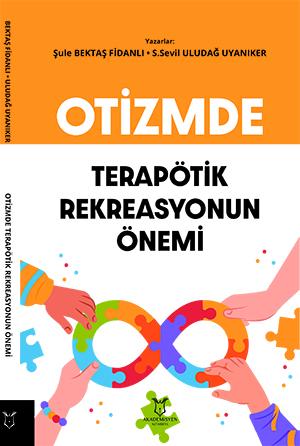
Otizmde Terapötik Rekreasyonun Önemi
Özet
-
Referanslar
Abadan, N. (1961). Üniversite Öğrencilerinin Serbest Zaman Faaliyetleri: Ankara Yüksek Öğrenim Gençliği Üzerine Bir Araştırma. Ankara: Ankara Üniversitesi Siyasal Bilgiler Fakültesi Yayınları.
Ağaoğlu, Y. S., ve Boyacı, M. (2013). Spor Yönetimi ve Bilgi Teknolojileri, 8(1), 17-23.
Ağaoğlu, Y.S., Taşmektepligil, M. Y., Albay, F., Bayrak, M., Paktaş, Y. Serbest Zaman Eğitimi ve Önemi. Millî Eğitim. Bahar 2006, Sayı 170, s.315
Akarsu, R., Kartal, K., ve Bumin, G. (2023). Okul Öncesi Çocuklarda Dansın Duyu-Algı-Motor Becerilere Etkilerinin İncelenmesi. Istanbul Gelisim University Journal of Health Sciences, (20), 431-443.
Akin, S., Kalkavan, A., ve Gülaç, M. (2016). Comparison of 10–11 years old athletes participating in interscholastic competitions and non-athletes children’s fundamental motor skills. Sportif Bakış: Spor ve Eğitim Bilimleri Dergisi, 21-32.
Antezana, L., Factor, R. S., Condy, E. E., Strege, M. V., Scarpa, A., ve Richey, J. A. (2019). Gender differences in restricted and repetitive behaviors and interests in youth with autism. Autism Research, 12(2), 274-283.
Arslan, E., ve İnce, G. (12). 12 haftalık egzersiz programının Atipik otizmli çocukların kaba motor beceri düzeylerine Etkisi. Uluslararası Spor Egzersiz ve Antrenman Bilimi Dergisi, 1(1), 51-62.
Austin, D. R. (2004). Therapeutic Recreation. 5. baskı. Illinois: Sagamore Publishing.
Axelsen M. (2009). Thepower of leisure: I was an anoexic; I’m now a healthytriathlete,LeisureSciences.31, p. 330–346.
Aydın, A. ve T. S. (2015). Otistik Çocuk Ebeveynlerinin Geniş Otizm Fenotipi ve Aleksitimi Özellikleri Arasındaki İlişki. Dumlupınar Üniversitesi Sosyal Bilimler Dergisi (41).
Aydın, A., ve T. S. (2015). Otistik Çocuk Ebeveynlerinin Geniş Otizm Fenotipi Ve Aleksitimi Özellikleri Arasındaki İlişki. Dumlupınar Üniversitesi Sosyal Bilimler Dergisi (41).
Bachman, J. E., ve Sluyter, D. (1988). Reducing inappropriate behaviors of developmentally disabled adults using antecedent aerobic dance exercises. Research in Developmental Disabilities, 9(1), 73-83. https://doi.org/10.1016/0891-4222(88)90021-2
Bailey, G. W., ve Hoffman, F. W. (1991). Sports and Recreation: Introduction Fads. Harr ing.
Bala, G., Katić, R., Krneta, Z. (2011). Do kinesiologic activities change aberrant behavior in preschool children? Collegium antropologicum, 35, 1007-1015.
Baumeister, A. A., ve MacLean Jr, W. E. (1984). Deceleration of self-injurious and stereotypie responding by exercise. Applied Research in Mental Retardation, 5(3), 385-393. https://doi.org/10.1016/S0270-3092(84)80059-4.
Bayless KG, Mull RF, Ross CM. Recreational Sports Programming., The Athletic.
Berk, L. E. (2013). Bebekler ve çocuklar. N. Işıkoğlu, Çev.) Ankara: Nobel.
Bhat, A. N., Galloway, J. C., ve Landa, R. J. (2012). Relation between early motor delay and later communication delay in infants at risk for autism. Infant Behavior and Development, 35(4), 838-846.
Bodfish, J. W., Symons, F. J., Parker, D. E., ve Lewis, M. H. (2000). Varieties of repetitive behavior in autism: Comparisons to mental retardation. Journal of autism and developmental disorders, 30, 237-243.
Bruikis, R. H., ve Bruinks, B. D. (2005). Bruiks-Oseretsky Motor Yeterlilik Testi, İkinci Baskı (BOT-2) https://doi.org/10.1037/t14991-000.
Carr, E. G., ve Durand, V. M. (1985). Developmental and functional assessment of problem behavior: A review of the literature. Journal of Applied Behavior Analysis, 18(3), 263-276.
Cederlund, M., Hagburg, B., ve Gillberg, C. (2009). Social and communication development in individuals with autism spectrum disorders. Journal of Autism and Developmental Disorders, 39(3), 397-407.
Chebli, S. S., Mart’in, V., ve Lanovaz, M. J. (2016). Prevalence of stereotypy in individuals with developmental disabilities: A systematic review. Review Journal of Autism and Developmental Disorders, 3, 107-118.
Chu, C. H., Tsai, C. L., Chen, F. C., Sit, C. H., Chen, P. L., ve Pan, C. Y. (2020). The role of physical activity and body-related perceptions in motor skill competence of adolescents with autism spectrum disorder. Disability and Rehabilitation, 42(10), 1373-1381.
Coyle, C. P., Kinney, W. B., Riley, B., & Shank, J. (1991). Benefits of therapeutic recreation: A consensus view. Temple University.
Çetiner, h. (2019). Sağlık rekreasyonu kapsamında terapatik rekreasyon uygulamaları. Journal of recreation and tourism research, 6(4), 405–411. Https://doi.org/ 10.31771/jrtr.2019.42.
Daly, Jim. Recreation And Sport Planning And Design.A Guidelines Manual. Australian.
Dawson, G., Meltzoff, A. N., Ostarling, J., ve Rinaldi, J. (1998). Neuropsychological correlates of early symptoms of autism. Child Development, 69(5), 1276-1285.
Demircioğlu, A., ve Uysal, S. A. (2017). Dikkat eksikliği hiperaktivite bozukluğu olan albinolu az görende fizyoterapi ve rehabilitasyon programının etkinliği: olgu sunumu. Journal of Exercise Therapy and Rehabilitation, 4(3), 139-144.
Derer, A. (2018). Otizmli Çocuklarda Fiziksel Aktivite, Motor Yeterlik ve Sosyal Beceri Düzeyinin İncelenmesi (Yüksek Lisans Tezi), Pamukkale Üniversitesi, Denizli.
Derer, H. (2018). Effects of physical activity participation on motor competence and social skills in children with autism spectrum disorder. Unpublished master’s thesis.
Diken, İ. H. (2013). Özel eğitime gereksinimi olan öğrenciler ve özel eğitim (7. Baskı). Diken, İ.H. (Ed.), Otistik bozukluğu olan öğrenciler (ss. 409-447). Ankara: Pagem Akademi.
Dorak, F. Yıldız, L. ve Sortullu, C. (2012). The effects of eight weeks of sports activities on self-sufficiency, social skills and some physical fitness parameters in children 9-10 years of age. Procedia-Social and Behavioral Sciences, (47), 1286-1291.
Eisenmajer, N., Ross, N., ve Pratt, C. (2005). Specificity and characteristics of learning disabilities. Journal of Child Psychology and Psychiatry, 46(10), 1108-1115
Emerson, E. (2001). Challenging behavior: Analysis and intervention in people with severe intellectual disabilities. Cambridge University Press.
Esentürk, O. K., ve Güngör, N. B. (2020). The effect of peer-mediated adaptive physical activity program on problem behaviors of mentally handicapped students. Journal of Education and Learning, 9(3), 163-173. https://doi.org/10.5539/jel.v9n3p163
Fabio, R. A., Giannatiempo, L., Antonietti, A., ve Budden, J. (2009). The role of early intervention in autism. Journal of Developmental Disabilities, 14(2), 85-96.
Ferreira, J. P., Ghiarone, T., Cabral Júnior, C. R., Furtado, G. E., Moreira Carvalho, H., Machado-Rodrigues, A. M., vd. (2019). Effects of physical exercise on the stereotyped behavior of children with autism spectrum disorders. Medicina ;55: 685. https://doi. org/ 10.3390/ medicina55100685
Friedman, N., Sadhu, J., ve Jellinek, M. (2012). DSM-5: Implications for pediatric mental health care. Journal of Developmental & Behavioral Pediatrics, 33(2), 163-178.
Fuller, E.A., Kaiser, A.P. The Effects of Early Intervention on Social Communication Outcomes for Children with Autism Spectrum Disorder: A Meta-analysis. J Autism Dev Disord 50, 1683–1700 (2020). https://doi.org/10.1007/s10803-019-03927-z
Gallahue, D. L. (1982). Assessing motor development in young children. Studies in Educational Evaluation, 8(3), 247-252.
Gallahue, D. L. (1982). Developmental Physical Education for All Children. New York: Wiley.
Gallahue, D. L., ve Ozmun, J. C. (1995). Understanding Motor Development: Infants, Children, Adolescents, Adults. New York: McGraw-Hill.
García-Villamisar, D., Dattilo, J., ve Muela, C. (2017). Effects of therapeutic recreation on adults with ASD and ID: A preliminary randomized control trial. Journal of Intellectual Disability Research, 61(4), 325-340. https://doi.org/10.1111/jir.12320
Gençöz, F. (1997). The effects of basketball training on the maladaptive behaviors of trainable mentally retarded children. Research in Developmental Disabilities, 18(1), 1-10. https://doi.org/10.1016/S0891-4222(96)00029-7
Gernsbacher, M. A. (2006). Toward a behavior of reciprocity. Journal of Developmental Processes, 1(2), 139-152.
Ginsburg, K. R., and Committee on Psychosocial Aspects of Child and Family Health. (2007). The importance of play in promoting healthy child development and maintaining strong parent-child bonds. Pediatrics, 119(1), 182-191.
Goldman, S., Siegel, M., ve Gifford, M. (2009). Prevalence and characteristics of stereotyped behaviors in children with autism spectrum disorders. Journal of Child Psychology, 38(4), 144-154.
Graefe, A. ve Parker, S., (1987). Recreation And Leisure, An Introductory Handbook, Venture Publishing Inc., 1640, Oxford Circle State College, PA 16803, s.16,57-60
Gratton, Chris., Taylor, Peter. Leisure in Britain Leisure Publications,1987, s.17
Hadi, G. E., Zengin, Ö., ve Ertüzün, E. (2023). Effect of Recreational Physical Activity Program on Aberrant Behaviors of Adolescents with Mild Intellectual Disabilities. Journal of Education and Recreation Patterns, 4(2), 263-274.
Hanley, G. P., Iwata, B. A., ve McCord, B. E. (2003). Functional analysis of problem behavior: A review. Journal of Applied Behavior Analysis, 36(2), 147-185. https://doi.org/10.1901/jaba.2003.36-147.
Heiman, M., Laberg, K. E., ve Nordoen, B. (2006). Imitative interaction increases social interest and elicited imitation in non-verbal children with autism. Infant and Child Development, 15(3), 297-309.
Hill, A. L. (2010). The role of motor skill development in the cognitive development of preschool children. International Journal of Child Development and Mental Health, 16(1), 1-13.
Honey, E., Leekam, S., Turner, M. vd. Repetitive Behaviour and Play in Typically Developing Children and Children with Autism Spectrum Disorders. J Autism Dev Disord 37, 1107–1115 (2007). https://doi.org/10.1007/s10803-006-0253-4
Hoogsteen, L., ve Woodgate, R. L. (2013). Embracing autism in C anadian rural communities. Australian Journal of Rural Health, 21(3), 178-182.
Howlin, P., Goode, S., Hutton, J., ve Rutter, M. (2004). Adult outcome for children with autism. Journal of child psychology and psychiatry, 45(2), 212-229.
Ingersoll, B. (2008a). The effect of context on imitation skills in children with autism. Research in Autism Spectrum Disorders, 2(2), 332-340.
Ingersoll, B. (2008b). The social role of imitation in autism: Implications for the treatment of imitation deficits. Infants ve Young Children, 21(2), 107-119.
Ingersoll, B. (2010). Brief report: Pilot randomized controlled trial of reciprocal imitation training for teaching elicited and spontaneous imitation to children with autism. Journal of Autism and Developmental Disorders, 40(9), 1154-1160.
Ingersoll, B. (2012). Brief report: Effect of a focused imitation intervention on social functioning in children with autism. Journal of Autism and Developmental Disorders, 42(8), 1768-1773.
Ingersoll, B., Lewis, E., ve Kroman, E. (2007). Teaching the imitation and spontaneous use of descriptive gestures in young children with autism using a naturalistic behavioral intervention. Journal and of Autism Developmental Disorders, 37(8), 1446–1456.
Ingersoll, B., ve Gergans, S. (2007). The effect of a parent-implemented naturalistic imitation intervention on spontaneous imitation skills in young children with autism. Research in Developmental Disabilities, 28(2), 163-175.
Ingersoll, B., ve Lalonde, K. (2010). The impact of nonverbal imitation training on language use in children with autism: A comparison of object and gesture imitation training. Journal of Speech, Language and Hearing Research, 53(4), 1040-1051.
Ingersoll, B., ve Meyer, K. (2011a). Do object and gesture imitation skills represent independent dimensions in autism? Journal of Developmental and Physical Disabilities, 23(5), 421-431.
Ingersoll, B., ve Meyer, K. (2011b). Examination of correlates of different imitative functions in young children with autism spectrum disorders. Research in Autism Spectrum Disorders, 5(3), 1078-1085.
Ingersoll, B., ve Schreibman, L. (2006). Teaching reciprocal imitation skills to young children with autism using a naturalistic behavioral approach: Effects on language, pretend play and joint attention. Journal of Autism and Developmental Disorders, 36(4), 487-505. Institute, USA, 1983, s.22.
İftar, G. K., Kürkçüoğlu, B. Ü., ve Kurt, O. (2018). Otistik çocuklar için davranışsal eğitim programı-II. Anı Yayıncılık.
Jensen, C. R. (1977). Leisure and Recreation: Introduction and Overview.
Kanne, S. M., ve Mazurek, M. O. (2011). Aggression in children and adolescents with ASD: Prevalence and risk factors. Journal of autism and developmental disorders, 41, 926-937.
Kanner, L. (1943). Autistic disturbances of affective contact. Nervous Child, 2, 217-250.
Kanner, L., ve Eisenberg, L. (1956). Child psychiatry; mental deficiency. Am J Psychiatry, 112: 5314.
Karadaş, C. Otizm spektrum bozukluğunda tekrarlayıcı davranışlar ve motor koordinasyon (Master's thesis, Eğitim Bilimleri Enstitüsü).
Karaküçük, S. (2012). Terapatik rekreasyon. Gazi Kitapevi.
Karaküçük, S., ve Başaran, Z. (1996). Stresle Başa Çıkmada Rekreasyon Faktörü. Gazi Beden Eğitimi ve Spor Bilimleri Dergisi, 1(4), 55-64.
Karasar, N. (2016). Bilimsel Araştırma Yöntemi: Kavramlar İlkeler Teknikler. Ankara: Nobel Akademik.
Kaur, M., Gochyyev, P., ve Tiwari, D. (2024). Use of standardized motor assessments in children with autism spectrum disorder: A meta-analysis and systematic review. Research in Autism Spectrum Disorders, 110, 102298.
Kaymak, A. (2016). Otizm Spektrum Bozukluğu (OSB): Tanım, Sınıflandırma, Yaygınlık ve Nedenler. Zihin Yetersizliği ve Otizm Spektrum Bozukluğu (Edt: İbrahim Halil Diken ve Hatice Bakkaloğlu), 1, 163-190.
Kelly, J. R. (1990). Leisure and aging: A second agenda. Loisir et Société/Society and Leisure, 13(1), 145-167.
Kelly, J. R. (1990). Leisure and aging: A second agenda. Society and leisure, 13, 145-167.
Kırcaali-İftar, G. (2005). Otistik özellik gösteren çocuklara iletişim becerilerinin kazandırılması. İstanbul: YA-PA.
Kırcaali-İftar, G. (2006). Otistik çocuklar için davranışsal eğitim programı (OÇİDEP). Yayımlanmamış eğitim semineri notları.
Kırcaali-İftar, G. (2007). Otistik çocuklar için davranışsal eğitim programı (OÇİDEP). Yayımlanmamış kurs notları.
Kırcaali-İftar, G. (2007). Otistik Çocuklar İçin Davranışsal Eğitim Programı İzleme Aracı (OÇİDEP-İZ). Yayımlanmamış değerlendirme aracı.
Kırcaali-İftar, G. (2007). Otizm spektrum bozukluğu. İstanbul: Daktylos Yayınları.
Koegel, R. L., ve Koegel, L. K. (Eds.). (1995). Teaching children with autism: Strategies for initiating positive interactions and improving learning opportunities. Paul H. Brookes Publishing Co.
Kozlowski, A. M., Matson, J. L., ve Sipes, M. (2012). Repetitive behaviors in autism: Prevalence, classification, and characteristics. Research in Autism Spectrum Disorders, 6(2), 699-709.
Kraus R. G. ve Curtis J.E. (1982). Creative management in recreation and parks: CV Mosby Company.
Küçük Ö, Ulaş G, Yaylacı F, Miral S. (2018). Geniş Otizm Fenotipi. Psikiyatride Güncel Yaklaşımlar, 10(2):228-248. doi:10.18863/pgy.358099.
Lackey, N. Q., Tysor, D. A., McNay, G. D., Joyner, L., Baker, K. H., ve Hodge, C. (2021). Mental health benefits of nature-based recreation: a systematic review. Annals of Leisure Research, 24(3), 379-393.
Lane, A.; Harpster, K. ve Heathcock, J. (2012). Motor Characteristics of Young Children Referred for Possible Autism Spectrum Disorder. Pediatric Physical Therapy, 24(1), 21-29.
Lane, S. J., Harpster, K. L., ve Heathcock, J. C. (2012). Motor control and planning in children with autism spectrum disorders. Autism Research, 5(1), 22-31.
LeBarton, E. S. ve Landa, R. J. (2019). Infant Motor Skill Predicts Later Expressive Language and Autism Spectrum Disorder Diagnosis. Infant Behavior and Development, 0(54), 37-47.
Libby, S., Powell, S., Messer, D., ve Jordan R. (1997). İmitation of pretend play acts by children with autism and down syndrome. Journal of Autism and Developmental Disorders, 27(4), 365-383.
Litwiller, F., White, C., Gallant, K. A., Gilbert, R., Hutchinson, S., Hamilton-Hinch, B., ve Lauckner, H. (2017). The benefits of recreation for the recovery and social inclusion of individuals with mental illness: An integrative review. Leisure Sciences, 39(1), 1-19.
Liu, T., ve Breslin, C. M. (2013). Bir Resim Aktivite Programının Otizm Spektrum Bozukluğu olan Çocuklar için MABC-2 Performansı Üzerine Etkisi. Çalışma ve Spor için Çeyrek Araştırma, 8484(2), 206-212. https://doi.org/10.1080/02701367.2013.784725
Lord, C., Risi, S., Lambrecht, L., Cook, E. H., Leventhal, B. L., DiLavore, P., Pickles, A., ve Rutter, M. (2000). The autism diagnostic observation schedule––Generic: A standard measure of social and communication deficits associated with the spectrum of autism. Journal of Autism ve Developmental Disorders, 30(3), 205–223.
Mazurek, M. O., ve Kanne, S. M. (2011). Repetitive behaviors in autism spectrum disorders. Journal of Autism and Developmental Disorders, 41(2), 1187-1198.
McClintock, K., Hall, S., ve Oliver, C. (2003). The prevalence and classification of challenging behaviors in people with intellectual disabilities. Journal of Intellectual Disability Research, 47(4), 343-349.
Means, L.E. (1973). Intramurals. Their Organization And Administration. Second Edition. Prentice-Hall, Inc. Englewood Cliffs, New Jersey, s.17.
MEB. (2013). Okul Öncesi Eğitimi Programı. MEB.
Mello, M. P., Goldman, S. E., Urbano, R. C., ve Hodapp, R. M. (2016). Services for children with autism spectrum disorder: Comparing rural and non-rural communities. Education and Training in Autism and Developmental Disabilities, 355-365.
Meyer, H. D., Brightbill, C. K. (1964). Communityrecreation, PrenticeHall, EnglewoodCliffs, Np.50.
Mosston, M., ve Ashworth, S. (2000). Çeviri: Eda Tüzemen. Düzenleme; Gıyasettin Demirhan, Beden Eğitimi Öğretimi, Bağırgan Yayınevi, Sporsal Kuram Dizisi, 30. Ankara, s.1.
Neumeyer, M. H., ve Neumeyer, E. S. (1958). Leisure and recreation: A study of leisure and recreation in their sociological aspects. New York: Ronald Press.
O’Neill, R. E., McDonnell, A. P., ve Kays, K. (2015). Assessment and intervention strategies for individuals with severe autism. Behavior Modification, 39(5), 789-814.
Obrusnikova, I., ve Miccinello, D. L. (2012). Parent perceptions of factors influencing after-school physical activity of children with autism spectrum disorders. Adapted physical activity quarterly, 29(1), 63-80.
Odabaş, C. (2016). Eğitilebilir Otizmli Çocuklarda Düzenli Spor Eğitiminin Bireysel Beceriler Üzerine Etkilerinin İncelenmesi, (Yüksek Lisans Tezi), (Danışman: Doç. Dr. Murat Akyüz), Bartın: Bartın Üniversitesi Eğitim Bilimleri Enstitüsü.
Ozmun, J. C., ve Gallahue, D. L. (2016). Motor geliştirme. Uyarlanmış Beden Eğitimi ve Spor E, 66 (375), 375-390.
Ozonoff, S.; Young, G. S.; Goldring, S.; Greiss-Hess, L.; Herrera, A. M.; Steele, J. ve Rogers, S. J. (2008). Gross Motor Development, Movement Abnormalities, and Early Identification of Autism. Journal of Autism and Developmental Disorders, 38(4), 644-656.
Ökcün Akçamuş, M. Ç., Bakkaloğlu, H., Demir, Ş., ve Bahap Kudret, Z. (2019). Otizm spektrum bozukluğunda Tekrarlayıcı Davranışlar Ölçeği-Revize Türkçe Sürümünün geçerlilik ve güvenilirlik çalışması. Anatolian Journal of Psychiatry/Anadolu Psikiyatri Dergisi, 20.
Pan, C. Y. (2014). Motor proficiency and physical fitness in adolescent males with and without autism spectrum disorders. Autism, 18(2), 156-165
Patry D. A, Blanchard C. M, Mask L. (2007). Measuring university students’ regulatoryleisurecopingstyles: plannedbreathesoravoidance?LeisureSciences, 29,p. 247–265
Patton, M. Q. (2002). Two decades of developments in qualitative inquiry: A personal, experiential perspective. Qualitative Social Work, 1(3), 261-283.
Petrus, C., Adamson, S. R., Block, L., Einarson, S. J., Sharifnejad, M., ve Harris, S. R. (2008). Effects of exercise interventions on stereotypic behaviours in children with autism spectrum disorder. Physiotherapy Canada, 60(2), 134-145.
Potvin, M. C., Snider, L., Prelock, P., Kehayia, E., ve Wood-Dauphinee, S. (2013). Recreational participation of children with high functioning autism. Journal of Autism and Developmental Disorders, 43(2), 445-457.
Provost, B.; Heimerl, S. ve Lopez, B. R. (2007). Levels of Gross and Fine Motor Development in Young Children with Autism Spectrum Disorder. Physical ve Occupational Therapy in Pediatrics, 27(3), 21-36.
Ravid, R. (2024). Practical statistics for educators. Rowman ve Littlefield.
Rogers, S. J., Hepburn, S. L., Stackhouse, T., ve Wehner, E. (2003). Imitation performance in toddlers with autism and those with other developmental disorders. Journal of child psychology and psychiatry, 44(5), 763-781.
Sacrey, L.-A. R.; Bennett, J. A. ve Zwaigenbaum, L. (2015). Early Infant Development and Intervention for Autism Spectrum Disorder. Sage Journals, 55(7), 699–709.
Schleien, S. J., Miller, K. D., Walton, G., ve Pruett, S. (2014). Parent perspectives of barriers to child participation in recreational activities. Therapeutic Recreation Journal, 48(1), 61-73.
Schmidt, R. A., ve Lee, T. D. (2019). Motor learning and performance 6th edition with web study guide-loose-leaf edition: From principles to application. Human Kinetics Publishers.
Sevlever, M., ve Gillis, J. M. (2010). Social and communication skills of children with autism. Journal of Autism and Developmental Disorders, 40(4), 462-474.
Shannon, C. A., Olsen, L. L., Hole, R., ve Rush, K. L. (2021). “There’s nothing here”: Perspectives from rural parents promoting safe active recreation for children living with autism spectrum disorders. Research in Developmental Disabilities, 115, 103998.
Smith, I. C., Reichow, B., ve Volkmar, F. R. (2015). The effects of DSM-5 criteria on number of individuals diagnosed with autism spectrum disorder: A systematic review. Journal of autism and developmental disorders, 45, 2541-2552.
Stumbo, N. J. ve Peterson, C. A. (2021). Therapeutic recreation program design: Principles and procedures (6th ed.). IL:Sagamore-Venture
Su, X., Long, T., Chen, L., ve Fang, J. (2013). Early intervention for children with autism spectrum disorders in China: A family perspective. Infants & Young Children, 26(2), 111-125.
Sussman, M. B. (2007). A curious calling: Unconscious motivations for practicing psychotherapy. Jason Aronson.
Şahin, S. (2016). 0-6 Yaş Arası Çocukların Temel Gelişimsel Özellikleri: Fiziksel ve Sosyal-Duygusal Gelişim. H. İ. Diken (Ed.), Erken Çocukluk Eğitimi (4.Baskı, ss. 170–208). Ankara: Pegem Yayıncılık.
Şener A, Terzioğlu R. G, Karabulut E. (2007). Life satisfactionandleisureactivitiesduringmen’sretirement: a Turkishsample. AgingandMentalHealth, 11 (1), p. 30–36.
Şenlik, M. K., ve Atılgan, E. (2019). The effect of regular exercise program on motor skills in adolescents with mild mental retardation. Journal of Exercise Therapy and Rehabilitation, 6(3), 140-148.
Tarr, C. W., Rineer-Hershey, A., ve Larwin, K. (2020). The effects of physical exercise on stereotypic behaviors in autism: Small-n meta-analyses. Focus on Autism and Other Developmental Disabilities, 35(1), 26-35.
Teıtelbaum, P.; Teıtelbaum, O.; Nye, J.; Fryman, J. ve Maurer, R. G. (1998). Movement Analysis in Infancy May be Useful for Early Diagnosis of Autism. Proceedings of the National Academy of Sciences, 95(23), 13982-13987.
Tepeli, K. (2012). Çocukların İstenmeyen Davranışlarına Karşı Annelerin Kullandıkları İletilerin Niteliksel Analizi. Humanities Sciences, 8(1), 138-158.
Tezcan, M. (1994). Boş Zamanların Değerlendirilmesi Sosyolojisi, Atilla Kitabevi.
Tonge, B., ve Einfeld, S. (2003). The clinical evaluation of autism spectrum disorders in children and adolescents. Psychiatric Clinics of North America, 26(1), 57-71.
Toper Korkmaz, Ö., ve Dike, İ. H. (2010). Stereotipik Davranışların Azaltılmasında Kullanılan Yöntemlerin Etkililiği: Betimsel ve Meta Analizi. Ankara Üniversitesi Eğitim Bilimleri Fakültesi Özel Eğitim Dergisi, 11(02), 1-12. https://doi.org/10.1501/Ozlegt_0000000149.
Töret, G., ve Özmen, E. R. (2014). Erken Çocukluk Döneminde Otizm Spektrum Bozukluğu Olan Çocuklarda Taklit Becerileri. Ankara Üniversitesi Eğitim Bilimleri Fakültesi Özel Eğitim Dergisi, 15(03), 51-68. https://doi.org/10.1501/Ozlegt_0000000214.
Tuna, A. (2022). Otizm Spektrum Bozukluğu Olan Çocuklarda Kalıplaşmış Davranışlar ve Kalıplaşmış Davranışların Yenilikçi Yaklaşımlarla Saptanması. Medeniyet Eğitim Araştırmaları Dergisi, 6(1), 65-73.
Turan, F., ve Ökçün-Akçamuş, M. Ç. (2013). Otistik spektrum bozukluğu olan çocuklarda taklit becerileri ve taklidin alıcı-ifade edici dil gelişimi ile ilişkilerinin incelenmesi. Türk Psikiyatri Dergisi, 24(2), 111-116.
Turkington, C., ve Anan, R. (2007). Autism Spectrum Disorders.
Türkoğlu, A., (1998). Karşılaştırmalı Eğitim, Adana, Baki Kitabevi, s.92
Tütüncü, Ö. (2008). Rekreasyon Yönetimine Yönelik Üniversite Düzeyinde Bir Müfredat Geliştirme Önerisi, Anatolia Turizm Araştırmaları Dergisi, 19 (12): 93-103.
Uludağ Uyanıker, S. S., ve Uysal, U. C. (2024). Otizmli bireylerde düzenli yapılan rekreasyonel etkinliklerin iyileştirici etkilerinin incelenmesi. International Aegean Conferences on Social Sciences ve Humanities-X, IKSAD Global Publications, İzmir, 05-07 October 2024, 104-113.
Uludağ-Uyanıker, S.S. ve Kurt, C. (2022). Evaluation of recreational practices for individuals wıth special needs in terms of their families: The case of muğla. Ases International Social Sciences Conference, May 27-29, 2022, Diyarbakır, Türkiye.
Uzunlular, Y. (2018). Yaygın gelişimsel bozukluk tanısı almış çocuklarda spor uğraşısının iyileştirici etkisinin incelenmesi: Aydın Efeler belediyesi otizm spor eğitim merkezi uygulaması. Yüksek Lisans Tezi, Çağ Üniversitesi / Sosyal Bilimler Enstitüsü.
Vilensky, J. A.; Damasio, A. R., ve Maurer, R. G. (1981). Gait Disturbances in Patients With Autistic Behavior: A Preliminary Study. Archives of Neurology, 38(10), 646-649.
West, K. L. (2019). Infant Motor Development in Autism Spectrum Disorder: A Synthesis and Meta-analysis. Child Development, 90(6), 2053-2070.
Yanardağ, M. (2007). Otistik çocuklarda farklı egzersiz uygulamalarının motor performans ve stereotip davranışlar üzerine etkileri. Doktora Tezi, Hacettepe Üniversitesi / Sağlık Bilimleri Enstitüsü / Spor Fizyoterapisi Ana Bilim Dalı.
Yıldız Çakır, L. (2022). Özel Gereksinimli Bireylerin Beden Eğitimi ve Spora Katılımına Rehber Yaklaşım (Beden Eğitimi ve Spor Öğretimi Alana Özgü Konular ve Temel Kavramlar), Pegem Akademi, Ankara, 254-270.
Yiğitoğlu, E., ve Odluyurt, S. (2021). Otizm Spektrum Bozukluğu Tanısı Koyan Doktorların Tıbbi Tanılama Sürecine İlişkin Görüşlerinin İncelenmesi. Ankara Üniversitesi Eğitim Bilimleri Fakültesi Özel Eğitim Dergisi, 22(1), 1-29. https://doi.org/10.21565/ozelegitimdergisi.635435.
Yücesoy Özkan, Ş., ve Gülboy, E. (2017). Otizmi Olan Çocukların Geçişler Sırasında Sergileyebilecekleri Problem Davranışları Önlemek Üzere Kullanılan Geçiş Stratejileri. Adıyaman Üniversitesi Sosyal Bilimler Enstitüsü Dergisi, (25), 53-97.
Yücesoy-Özkan, S. (2018). Otizm spektrum bozukluğu: Erken tanı, müdahale ve yönetim. Eğitim Akademisi Yayınları.
Yüksel, A. (2005). Otizm genetiği. Cerrahpaşa Tıp Dergisi, 36(1), 35-41.
Zachor, D. A.; Ilanit, T. ve Itzchak, E. B. (2010). Autism Severity and Motor Abilities Correlates of Imitation Situations in Children with Autism Spectrum Disorders. Research in Autism Spectrum Disorders, 4(3), 438-443.
Zwaigenbaum, L., Bryson, S., Rogers, T., Roberts, W., Brian, J., ve Szatmari, P. (2005). Behavioral manifestations of autism in the first year of life. International journal of developmental neuroscience, 23(2-3), 143-152.
Yayınlanan
Lisans
LisansBu İnternet Sitesi içeriğinde yer alan tüm eserler (yazı, resim, görüntü, fotoğraf, video, müzik vb.) Akademisyen Kitabevine ait olup, 5846 sayılı Fikir ve Sanat Eserleri Kanunu ve 5237 sayılı Türk Ceca Kanunu kapsamında korunmaktadır. Bu hakları ihlal eden kişiler, 5846 sayılı Fikir ve Sanat eserleri Kanunu ve 5237 sayılı Türk Ceza Kanununda yer alan hukuki ve cezai yaptırımlara tabi olurlar. Yayınevi ilgili yasal yollara başvurma hakkına sahiptir.